As solar energy adoption accelerates across the Philippines, the country’s largest power distributor is raising the alarm over unregulated installations that could compromise both consumer safety and grid stability.
During a recent Senate hearing, Manila Electric Co. (Meralco) urged the government to establish strict technical standards for rooftop solar equipment and to regularize unregistered installations that currently bypass the formal application process.
Supporting a Streamlined Net Metering Program
Meralco Vice President and Head of Utility Economics, Lawrence Fernandez, expressed the company’s support for amendments to the Renewable Energy Act proposed by Senator Sherwin Gatchalian. These amendments aim to grant the Energy Regulatory Commission (ERC) the authority to redefine the scope of the net metering program and simplify the often-tedious permitting process.
Currently, under the 2008 Renewable Energy Act, the net metering program allows customers to install renewable energy facilities up to 100 kilowatts (kW). Any excess electricity exported back to the grid is compensated through monthly bill credits.
The Challenge of Unregistered Solar Systems
While the transition to renewable energy is vital for energy security, Fernandez highlighted a growing concern regarding systems that operate outside the official framework.
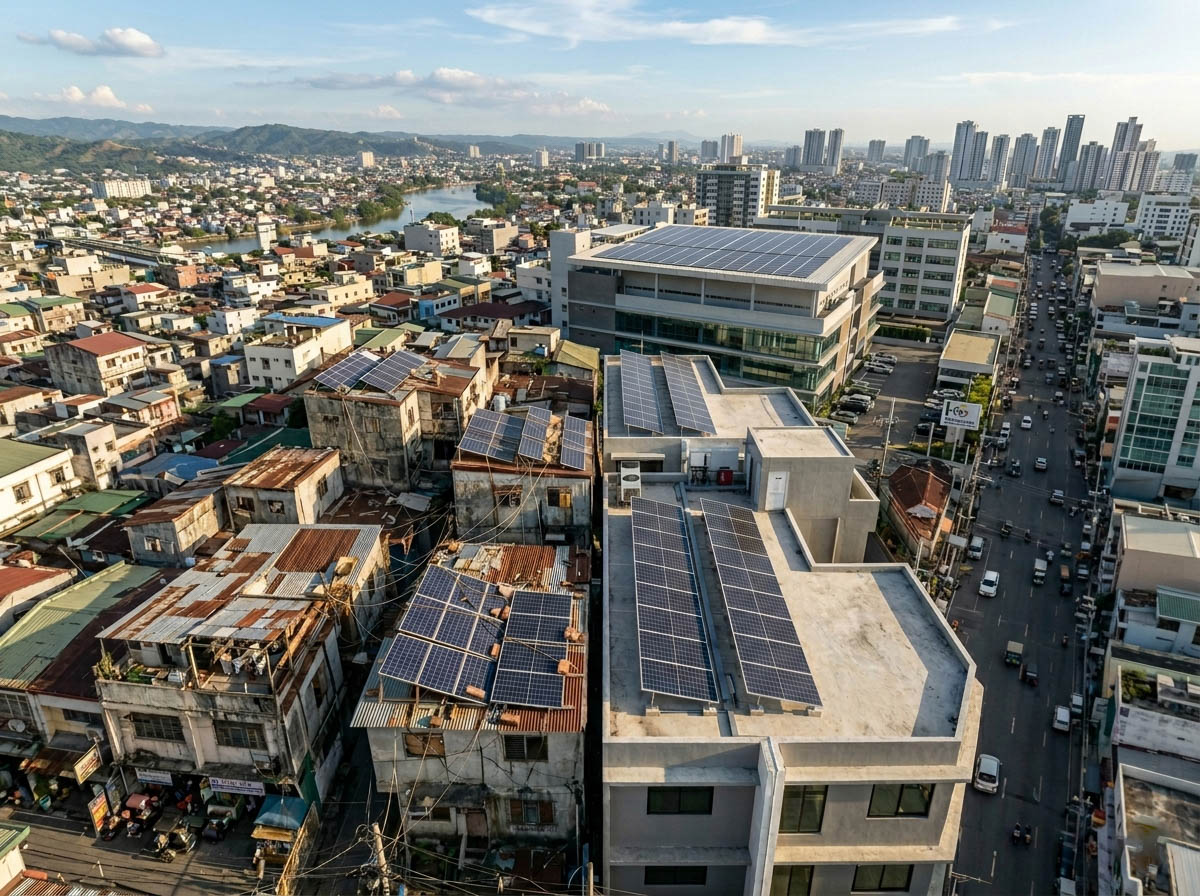
Citing a study by the Institute for Climate and Sustainable Cities (ICSC), Fernandez noted that roughly one-third of rooftop solar units in Meralco’s franchise area are unregistered. These are setups installed without local government permits, official safety inspections, or formal notification to the utility.
The ICSC study used Google Earth satellite imagery to compare physical installations against the ERC’s official database, revealing a significant gap between what is actually on Filipino rooftops and what is officially recorded.
“There are a lot of installations compared to what’s registered. The bill can include a provision on how the industry can regularize those unregistered installations,” Fernandez suggested, noting that streamlining the process would encourage these owners to come forward and ensure their systems meet safety benchmarks.
A Call for Equipment Standards and Qualified Installers
Beyond the registration process, Meralco is calling on the Department of Energy (DOE) and the Department of Trade and Industry (DTI) to formalize standards for solar hardware, specifically inverters.
“We have seen that there is already a standard for inverters, but there are installers who do not use those inverters that adapt to international standards,” Fernandez said. He also emphasized the need for the government to adopt formal qualifications for solar installers to protect the public from substandard workmanship and potential fire hazards.
The Scale of Solar in the Meralco Grid
The scale of solar adoption is already significant. Meralco currently hosts over 20,000 net metering installations with a combined capacity of over 170 megawatts (MW). However, when including larger commercial establishments that operate outside the 100kW net metering limit, the total registered solar capacity in Meralco’s area exceeds 500 MW.
With the Philippines facing high electricity prices and energy volatility linked to global events, the push for solar is stronger than ever. However, for Juan to build a truly sustainable future, the industry must balance rapid growth with technical integrity and transparency.

While the push for regulation and technical standards is a valid safety concern, it also raises questions about market competition. By tightening regulations and standardizing hardware, Meralco creates a more structured environment that could possibly favor large, established players, including its own solar arm, MSpectrum.
As we move toward a greener Philippines, it is essential that regulations protect the consumer without creating barriers that stifle the democratization of energy for every Filipino household.