
Electricity powers every modern convenience in our homes, from air conditioning units and kitchen appliances to high-definition entertainment systems. However, an electrical system is only as reliable as its underlying safety measures. Whether you are planning a room renovation, installing heavy-duty equipment, or simply trying to understand why a breaker trips when multiple appliances run simultaneously, having a clear grasp of electrical fundamentals is essential. This comprehensive guide breaks down three core pillars of residential electrical safety—circuit breakers, wire gauges, and grounding systems—to help you keep your property secure and fully functional.
The First Line of Defense: Circuit Breakers and Panel Capacity
At the heart of every residential electrical setup lies the main breaker panel, which acts as the distribution center and primary safety valve for your entire home. Electricity enters the panel from the utility line and is divided into individual branch circuits that feed specific zones or high-demand appliances. Each branch circuit is governed by a circuit breaker designed to automatically interrupt the flow of electricity whenever the current exceeds safe operational limits.
Circuit breakers protect against two primary hazards: overloads and short circuits. An overload occurs when too many appliances draw power from a single circuit at the same time, forcing more electrical current through the wires than they were engineered to handle. A short circuit happens when a hot wire directly touches a neutral or ground wire, causing a sudden, massive spike in current. In both scenarios, the internal mechanism of the breaker trips to cut off power, preventing wires from overheating and melting their insulation, which is one of the leading causes of residential electrical fires.
Matching Wire Gauges to Circuit Breakers
While circuit breakers act as safety switches, the electrical wires running behind your walls function as the highway system. Electrical wire thickness is measured using the American Wire Gauge (AWG) system, where a smaller gauge number corresponds to a thicker wire capable of safely carrying more electrical current. Selecting the correct wire gauge for a given breaker amperage is a non-negotiable rule of electrical safety.
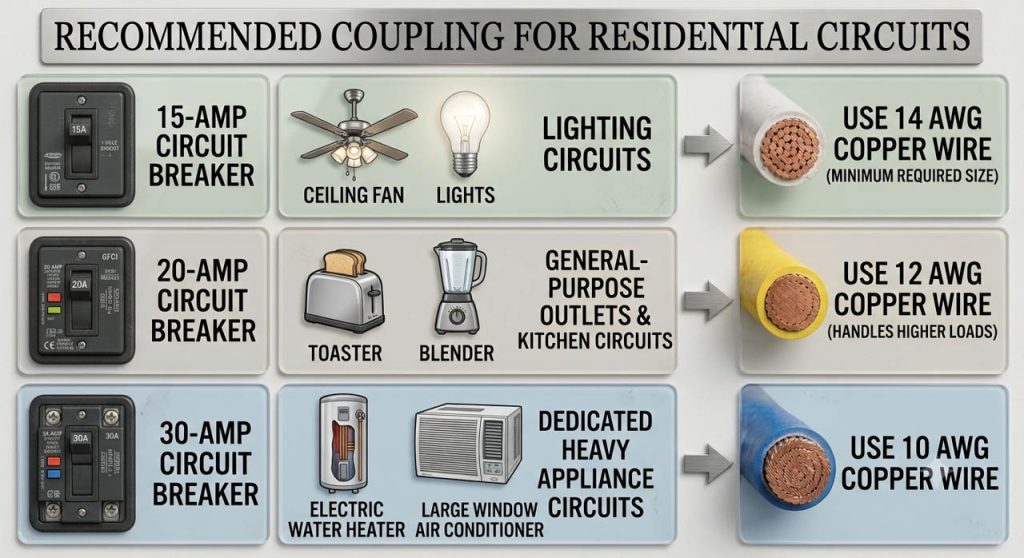
For standard residential lighting circuits protected by a 15-amp breaker, 14 AWG copper wire is the minimum required size. General-purpose convenience outlets and kitchen circuits typically run on a 20-amp breaker, which demands thicker 12 AWG copper wire to handle higher electrical loads safely. Dedicated circuits for heavy appliances, such as electric water heaters or large window air conditioners, usually require a 30-amp breaker paired with 10 AWG copper wire. Using a wire that is too small for the breaker rating, such as wiring a 20-amp breaker with 14 AWG wire, creates a dangerous hazard where the wire can overheat and ignite nearby building materials long before the breaker ever trips.
Grounding Systems and GFCI Protection in High-Risk Zones
Beyond breakers and wire sizing, a robust grounding system provides the ultimate safeguard against electric shock. Electrical current always seeks the path of least resistance to return to the ground. Under normal operating conditions, current flows seamlessly through the hot and neutral wires. However, if an internal wire comes loose and touches the metal housing of an appliance, the entire exterior frame can become energized and pose a lethal shock hazard to anyone who touches it.
A properly installed grounding system creates a safe alternative path for stray electricity. The ground wire connects every outlet, light fixture, and appliance chassis back to the main panel, which is anchored directly to the earth via a heavy copper grounding rod driven deep into the soil. If a fault occurs, the stray current travels instantly down the ground wire, causing a rapid spike in current that immediately trips the circuit breaker and shuts off power.

In wet or damp environments like bathrooms, kitchens, laundry areas, and outdoor spaces, standard grounding is paired with Ground Fault Circuit Interrupter (GFCI) protection. GFCI devices constantly monitor the balance of electrical current flowing between the hot and neutral wires. If the device detects a tiny leakage of current, such as electricity passing through water or a human body, it cuts off the power supply in milliseconds, preventing severe electrical injury.
Spotting Signs of Electrical Overload and System Strain
Recognizing early warning signs of electrical strain can save homeowners from costly repairs or hazardous emergency situations. Dimming or flickering lights when heavy appliances switch on usually indicates that a circuit is working near its maximum capacity. Warm switch plates, discolored wall outlets, faint buzzing sounds from the panel, or burning odors near outlets are clear indicators of dangerous heat buildup caused by loose connections or overloaded wires.
While basic knowledge empowers property owners to make informed decisions and communicate effectively with contractors, physical panel work and internal house rewiring should always be performed by a qualified, licensed electrician. Prioritizing correct wire sizing, functional circuit breakers, and reliable grounding ensures your home remains safe, efficient, and ready to handle modern electrical demands.
Disclaimer: This guide is intended solely for educational and informational purposes to help homeowners understand basic residential electrical concepts. Working with electrical systems carries inherent risks, including electric shock, severe physical injury, and property damage from fire hazards. Readers should never attempt internal panel modifications, structural rewiring, or complex installations without proper technical training. Always consult and hire a qualified, licensed electrician, and ensure that all electrical work strictly complies with the Philippine Electrical Code and local building regulations.