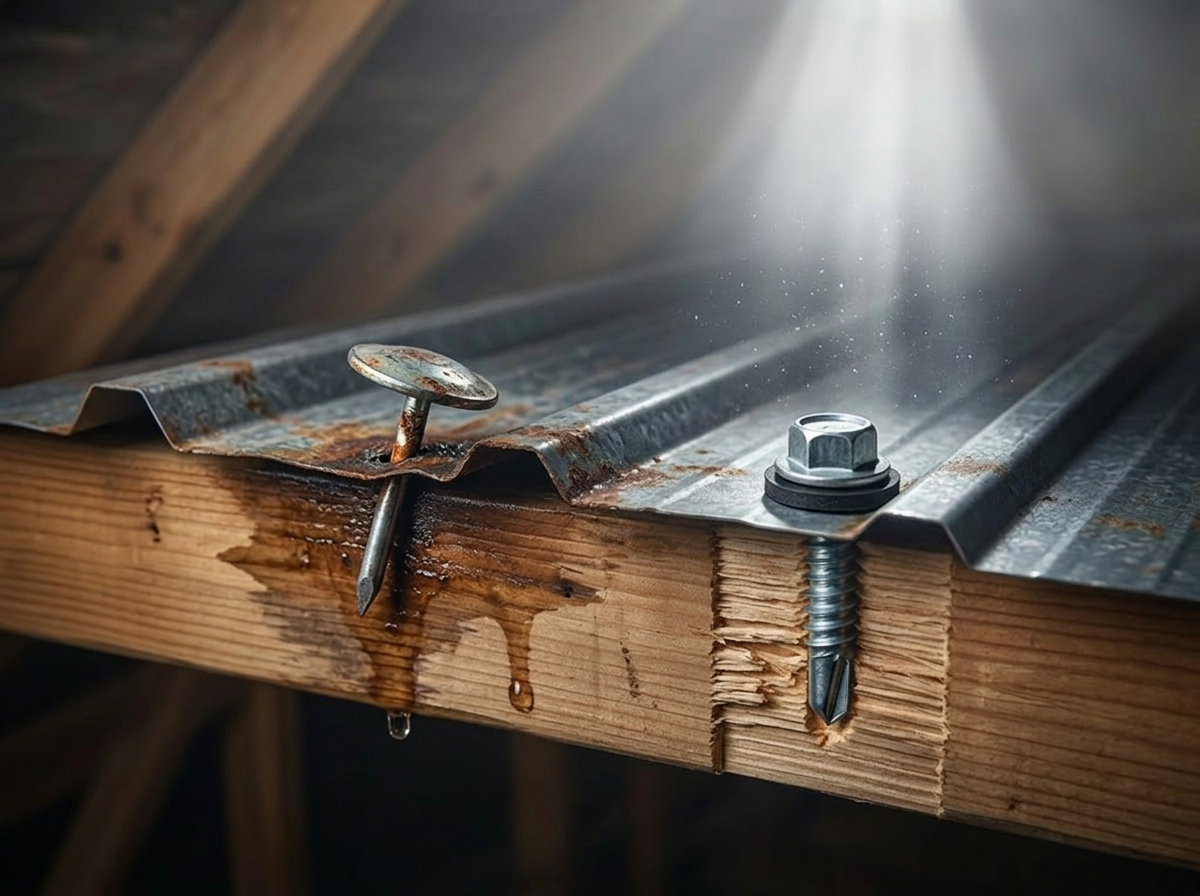
The rainy season in the Philippines has a special way of revealing the hidden flaws in our homes. You are sitting comfortably in your living room, listening to the heavy downpour of the afternoon habagat, when suddenly you hear a slow, rhythmic pat-pat-pat hitting your ceiling board. Within an hour, a dark brown ring starts spreading across your painted ceiling, directly underneath your galvanized iron roof sheets. We know that when homeowners spot these leaks, their first instinct is to buy a bucket of cheap roof sealant and slap it over the leaks. But before you climb up that slippery ladder, we need to talk about the root cause of this annual disaster because the real culprit isn’t usually a hole in your metal sheets, but is the humble umbrella nail that has slowly lost its grip on your home.
For generations, the standard way to secure G.I. roofing sheets in our country was using classic umbrella nails, or pako sa bubong / pakong yero. They were cheap, easy to hammer in, and worked perfectly fine when the wood underneath was brand new. But the physics of a tropical roof is relentless. Under the blistering sun, your metal roof sheets can easily heat up to over 60 degree Celsius during the midday hours, only to cool down rapidly to 25 degree Celsius during a sudden afternoon thunderstorm. This extreme thermal cycling forces your metal sheets to expand and contract constantly. Since concrete and wood do not expand at the exact same rate, this movement puts massive lateral pressure on the smooth shank of your umbrella nails, gradually loosening the friction holding them in place.
Adding to this thermal tug-of-war is the dynamic force of wind uplift during our yearly typhoon season. When strong winds of over 120km/h sweep across your roof, they create a powerful suction effect that pulls upward on your G.I. sheets. This continuous, micro-vibration acts like a claw hammer, slowly but surely backing those smooth-shanked nails out of the wooden purlins. Once a nail has backed out by even just 3mm, the nail is no longer pressed firmly against the metal sheet. The next rain shower will find this tiny gap, allowing water to run straight down the shaft of the nail, soaking your wooden purlins, and eventually destroying your gypsum ceiling board.
More importantly, standard umbrella nails are simply not built to survive the harsh UV rays of the Philippine sun. To make matters worse, as water pools around the unshielded nail head, it triggers galvanic corrosion between the steel nail and the G.I. sheet, creating rust that eats away at the metal and turns a small leak into a major structural failure.
If your roof is built on a wooden frame, remember that wood is a an organic material that absorbs moisture from the air during humid and rainy season causing it to swell, while during hot dry season, they shrink. This constant expansion and contraction is why roofing nails will always work themselves loose over time. If you want a roof that stays dry, you need a fastener that actually mechanical-locks into the structure.
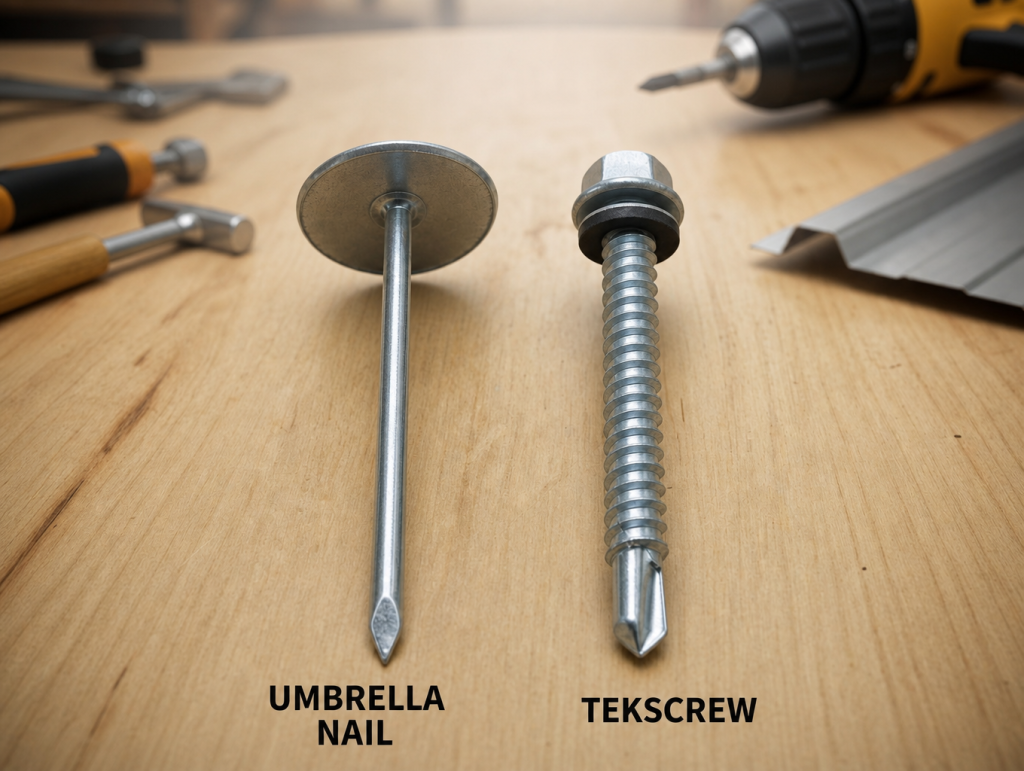
This mechanical lock is exactly why modern builders have completely shifted to self-drilling screws, widely known in the local market as tekscrews. Unlike smooth nails, tekscrews feature deep, engineered threads that bite into the wood or steel purlins with incredible force. To put it in perspective, a single standard tekscrew has more than double the pull-out resistance of an old-school umbrella nail. When wind uplift pulls on your roof, the threads of the tekscrew distribute the force deeply into the structural frame, preventing the fastener from backing out even during strong typhoons.
Furthermore, tekscrews are equipped with washers that are specifically engineered to resist extreme UV exposure, high temperatures, and ozone degradation. These washers remain flexible and elastic for years, maintaining a watertight, compressed seal over the screw hole even as the roof sheets expand and contract in the heat.
To guarantee that your roof upgrade actually lasts, you must ensure that your fasteners meet rigorous international durability standards. In our humid climate, using cheap, unrated screws will only lead to rusted fasteners that snap under stress. When sourcing your supplies, always look for tekscrews with a verified Class 3 galvanization or mechanical zinc coating, which provides the critical barrier needed to resist rust in high-salinity coastal areas.
Ultimately, preventing roof leaks is about moving away from temporary band-aid solutions like cheap sealants and investing in the correct structural fasteners. By replacing your backing-out umbrella nails with high-performance, thread-locking tekscrews, you are taking a massive step toward protecting your ceilings, your electrical wiring, and your family’s peace of mind. Building it right means planning for the elements, and a dry home starts with a roof that is locked down to last.